A workshop that teaches your team stable performance under pressure, in the face of uncertainty and constant change.
Employees may have excellent CVs, completed numerous training programmes and know procedures perfectly. Why then, in the face of crisis, restructuring or an approaching deadline — does the system stop functioning?
Because mental toughness is not an inborn talent, given once and for all. It is a muscle. If you don't train it as a team – it withers.You can transform a group of stressed specialists into an organisation that adapts to changes in real-time.
When pressure rises, the weakest links break.
In an environment of constant change, a lack of systemic mental resilience reveals itself very quickly. It can be recognised by hard operational indicators:
Quiet Quitting (doing the absolute safe minimum)
Technological changes and new strategies are met with significant resistance. We dramatically reduce quiet disengagement and restore genuine commitment.
Abandoning projects at the finish line
A great start with plenty of energy, but when the process becomes tedious and requires deferred gratification — quality drops dramatically.
Blame Culture
When a situation spirals out of control, constructive discussions turn into emotional emails and finger-pointing instead of rapidly mapping solutions.
Accountability Avoidance
Employees prefer to stay silent in meetings and wait for 100% direction from their manager, paralysing the decision-making capacity of the entire department.
A team like a flexible willow. Adaptation beats rigid strength.
Many leaders often equate resilience with being rigid, devoid of emotions like an oak. But during a corporate 'storm', it is precisely the rigid oak that can break first.
We teach teams to be like a flexible willow – you yield to gusts of wind (changes), so you can quickly return to your original shape without damage.
You will build a workplace culture where:
- Teams can start acting with just 70% of the information, without waiting for complete clarity.
- Motivation is no longer needed to begin work — the team has habits that trigger flow even in demanding tasks.
- A mistake becomes merely a speed bump, a quick piece of feedback — not a reason for professional drama.
MTQ RESILIENCE WORKSHOPS (Mental Toughness)
15% theory and tools, 85% practice and real-life scenarios.
Our team workshops are not motivational lectures. These are concrete tools that your people will start applying the very next day.
Before the training begins, each team member fills in the MTQ Plus questionnaire. This way we don't work on guesses – we arrive with a ready-made "Team Resilience Map".
We start with hard data: we show you how your brains physiologically react to stress, change, uncertainty and responsibility. Then we implement tools that immediately lower cortisol levels and restore cognitive control to your team.
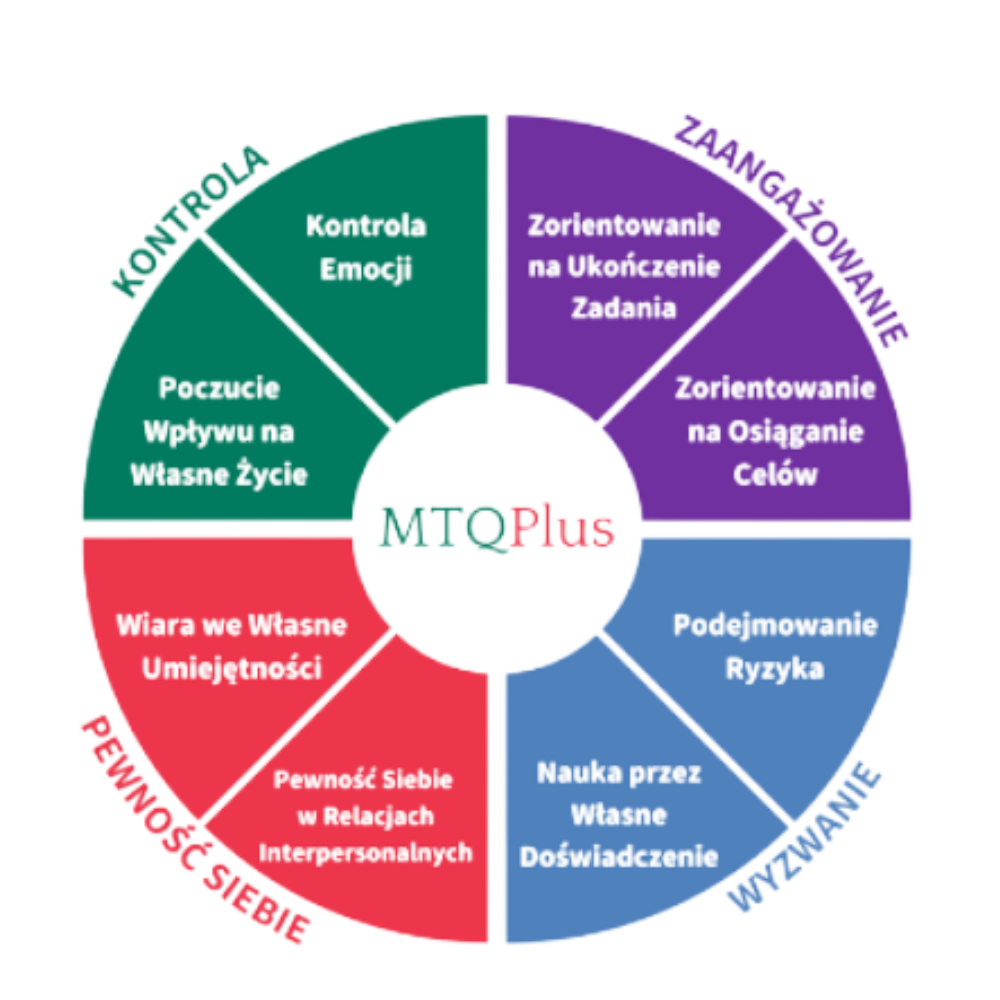
The 4C Model - What exactly do we diagnose and train?
75% of all mental toughness research in the world is based on this model. These are precisely the 4 areas we diagnose in each participant before training and on which we build the mental strength of your entire team.
Control
The ability to maintain emotional self-regulation when things go wrong.
Commitment
The consistency to deliver results when initial motivation fades.
Confidence
The courage to speak up and act despite the risk of criticism.
Challenge
Does the brain perceive change as a threat or a problem to solve?
Control
Emotional management and composure under pressure
When your team raises its Control level, employees will be able to:
- Quickly 'reset' your mind after a difficult client conversation or rejection, instead of wasting the rest of the day analyzing failure.
- Keep a cool head and stick to strategy when the market, project or negotiations suddenly get out of control.
- Focus 100% on what they have real influence over, instead of wasting energy complaining about procedures, inflation or 'top-down' decisions.
Commitment
Consistency and delivering results to the finish line
When your team strengthens its Commitment, employees will be able to:
- Deliver tedious and long-term projects to completion, maintaining work pace even when initial enthusiasm completely fades.
- Independently maintain discipline, without the need for constant 'motivation pumping' and micromanagement by the manager.
- Consistently achieve goals (KPIs) and promises made to clients, regardless of obstacles and delays piling up.
Confidence
Assertiveness and strength in interpersonal relationships
When your team builds genuine Confidence, employees will be able to:
- Firmly defend margins and assertively negotiate terms, not giving in to the first discount pressure from the buyer.
- Courageously speak up at important meetings, fearlessly sharing innovative – even risky – ideas.
- Professionally and unemotionally set boundaries in relationships with demanding clients or colleagues.
Challenge
Agility (Agility) and adaptation to change
When your team raises its Challenge level, employees will be able to:
- Smoothly and without resistance adapt to new technologies (e.g. AI), mergers or sudden changes in company strategy.
- Proactively step out of the comfort zone to test new ways of reaching difficult clients, instead of sticking to old patterns.
- Treat mistakes as quick feedback, not a reason for hiding problems and creating a 'culture of excuses' in the department.
Important: The MTQ assessment is NOT a personality test. It is a precise profile of your current stress reactions.
What do the workshops look like in practice?
Fill in MTQ test
Validated, scientific online questionnaire
Choose format
Individual session (60 min) or team workshop (7-8h)
Set location
You decide where the workshop takes place
Set date
We adapt the date to your calendar
Resilient team
Team ready for any challenge
Fill in MTQ test
Validated online questionnaire
Choose format
60 min session or 7-8h workshop
Set location
You decide about location
Set date
We adapt to your calendar
Resilient team
Ready for challenges
What will we teach your team?
During the workshops we provide tools that the team can use even 5 minutes before an important meeting. We will teach you, among others:
Confident decisions with incomplete data
How to make fast, accurate decisions without analytical paralysis.
Post-failure debrief
An engineering approach to mistakes — deconstructing lost deals without toxic blame-seeking. The mistake becomes pure feedback.
Switching from panic mode to operational mode
Instantly re-engaging the brain with just one question.
Deep Work Focus Blocks
Eliminating cognitively costly attention restarts and delivering tasks without burnout.
Harvard Feedback Framework
Setting boundaries and delivering feedback assertively and without fear.
Attention management in chaos (overstimulation shield)
A tool to protect against information overload and maintain focus on what truly matters.
Tension-cutting algorithm
A proven method for neutralising stress right before a difficult conversation, margin defence or high-stakes negotiation.
S.O.S. Protocol
A rapid rescue technique — regain composure in 4 seconds when stress hits unexpectedly.
Personal Resilience Protocol (Playbook)
A personalised set of procedures tailored to your individual stress triggers — you leave with a ready-to-use plan.
What should you expect after training?
Secure your company's financial results.
Teams trained in mental resilience based on the 4C model report measurable benefits:
Reduction in sick-leave absence
A measurable drop in absenteeism and presenteeism (physically present, mentally absent).
Fewer decision-making errors
A significant reduction in critical-moment errors through better emotional regulation and an analytical approach to problems.
Increased talent retention
Employees leave less frequently at the first sign of difficulty, building loyalty grounded in psychological safety.
Faster adaptation cycles (Agility)
The team moves more rapidly from resistance to a new strategy into the phase of effective execution.
Higher negotiation effectiveness
More consistent sales results through better emotional regulation and armour-grade resilience to rejection.
Increased innovation
Higher interpersonal confidence means employees share risky ideas more boldly.
Next step
There will always be pressure, uncertainty and change in the market. The question is: who will react to them better – your team or the competition?
We guarantee 100% substantive consultation where you can talk to our certified trainer about your team's challenges.
We design every workshop individually - for your team
Leaders and their teams trust us